
Decades after a video game ships, long after its developers have moved on and its studio may have closed, a dedicated community of players is still digging through its code, and they are still finding things nobody knew were there. Buried glitches, forgotten shortcuts, and impossible tricks keep surfacing in games old enough to be considered ancient by the standards of the industry. This ongoing excavation is one of the most fascinating and least understood corners of gaming culture, and it sits at the intersection of competition, engineering, and something that genuinely resembles archaeology. The people driving it are speedrunners, and the tools they use to unearth these secrets are more sophisticated than most players ever imagine.
Speedrunning, at its simplest, is the act of completing a video game, or a section of one, as fast as humanly possible. But the fastest routes are rarely the ones the designers intended. To shave off seconds, and then to shave off more, runners turn to sequence breaking, deliberately playing the game out of its designed order, and to glitches, exploiting flaws in the game’s code to skip whole sections or achieve things that should be impossible. A wall that was meant to be solid becomes something to clip through. A loading zone meant to sit at the end of a level can be reached from somewhere it was never supposed to be. The community even splits into categories to keep things fair, with glitchless runs testing pure mechanical skill, and unrestricted runs where anything the code allows is permitted, no matter how absurd it looks.
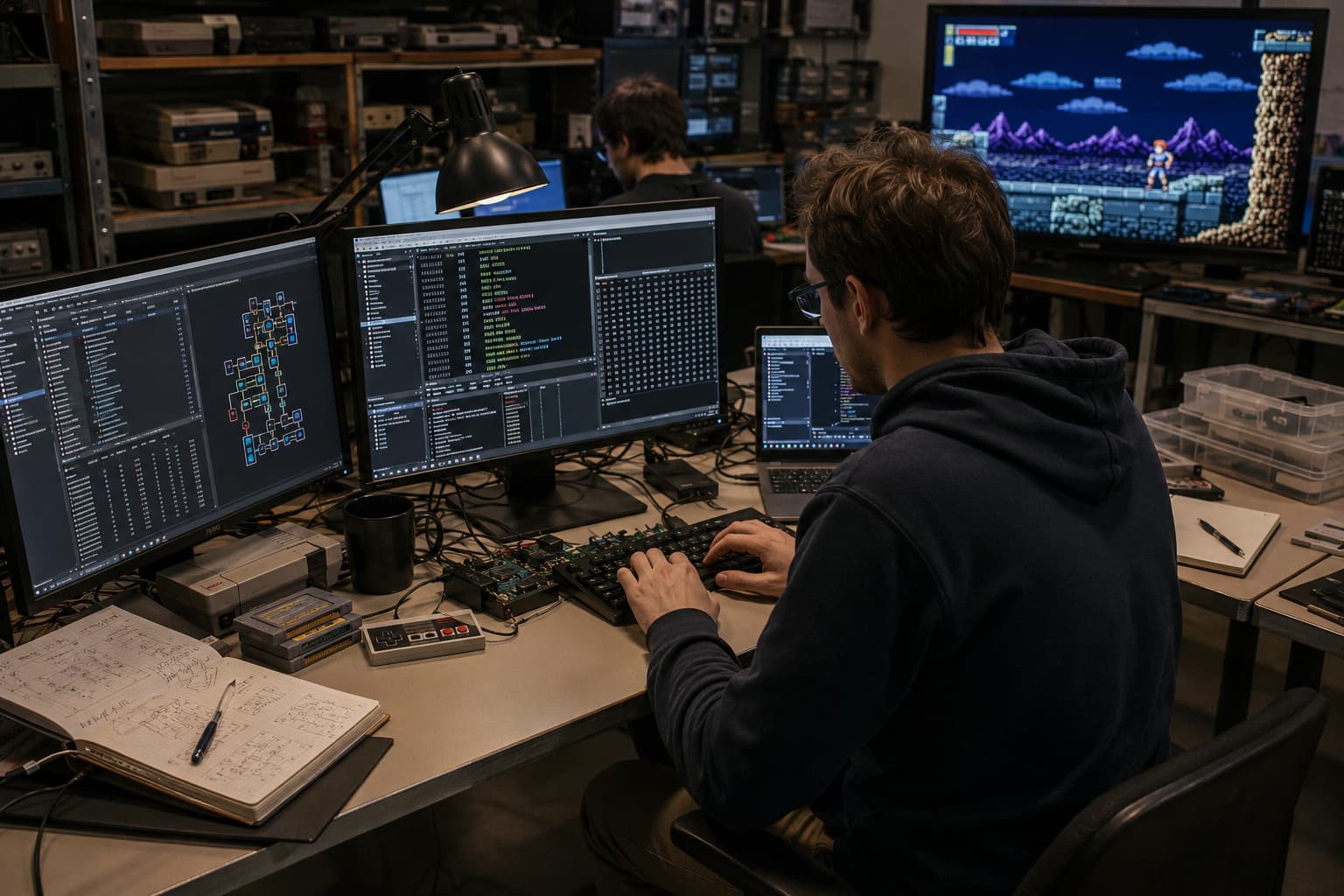
What separates modern glitch hunting from just messing around is the methodology, and this is where it stops being play and starts being research. The most dedicated members of these communities are not simply trying weird things over and over, though that helps. They are reverse-engineering the software. Remarkably, they reach for the same tools used by professional cybersecurity researchers, disassemblers and debuggers that pull a program apart to reveal how it works internally. Using an emulator’s memory viewer, a glitch hunter can pause a decades-old game, step through it a single frame at a time, and watch exactly how the machine’s memory changes in response to every button press. They are, in effect, performing an autopsy on the game, mapping its internal data structures and hunting for the exact conditions under which it breaks.
This is why some observers have started calling speedrunners vulnerability researchers, and the comparison is startlingly apt. The techniques used to break a video game are strikingly similar to those used to find security holes in real software. A glitch that lets a player corrupt the game’s memory in a controlled way is, conceptually, the same kind of flaw that a hacker exploits in a web browser. In fact, the most advanced runners have taken this to an extraordinary conclusion. By feeding a game a precise sequence of inputs, they can trigger what amounts to arbitrary code execution, essentially reprogramming the game from the inside using nothing but controller presses. At the largest speedrunning events, audiences have watched a robot press buttons on an unmodified console fast enough to rewrite one classic game into an entirely different one, live on stage, a feat that would have seemed like sorcery to the game’s original programmers.
A crucial part of this world is the tool-assisted speedrun, or TAS. Here the player uses emulation to slow the game down, save and reload its exact state, and craft a sequence of inputs frame by frame that no human hands could ever execute in real time. A TAS is not a legitimate competitive run, and everyone understands that; it exists for research. It reveals the theoretical limit of what a game can do, and the tricks it uncovers often trickle down to human runners who then spend months learning to perform a simplified version by hand. Some of the most famous discoveries in speedrunning history began as a TAS demonstration that looked impossible, only for a determined player to later find a consistent, run-viable way to pull it off live. TAS work also serves an unexpected policing function, because a perfectly precise simulation of a game’s code can be used to verify whether a claimed record was even physically possible, and more than one celebrated old record has been stripped after analysis proved it had been faked.
There is a genuinely archaeological quality to all of this. Researchers have gone back through classic games and formally catalogued their flaws, in one academic study classifying more than two hundred distinct glitches across a handful of old titles and even identifying categories of software weakness that are unique to games and absent from standard engineering taxonomies. The knowledge accumulates like a scientific field, with glitch hunters worldwide sharing discoveries that others combine into ever more intricate techniques, each new find building on the last. A trick that reshaped an entire game’s record was often the work of one obscure hunter whose name only the community knows.
Beyond the competition and the spectacle, this work matters for a reason that reaches past speedrunning itself: preservation. Every game that gets torn apart and understood this deeply is a game whose inner workings are documented, mapped, and kept alive long after the hardware it ran on becomes obsolete. In prying open these old programs, the community is building a detailed record of how they were actually made, quirks, mistakes, and all. Long after a game is commercially forgotten, its code lives on as an object of study, endlessly re-examined by people who treat a twenty-year-old cartridge the way a historian treats an ancient manuscript. The developers built these worlds to be played. It turns out they also built something to be excavated, and the diggers have no intention of stopping.